Hawker Eviction & the Politics of Bulldozer Raj
A brief study of a facet of politics, new to Bengal.
Team Subaltern
6/17/20268 min read
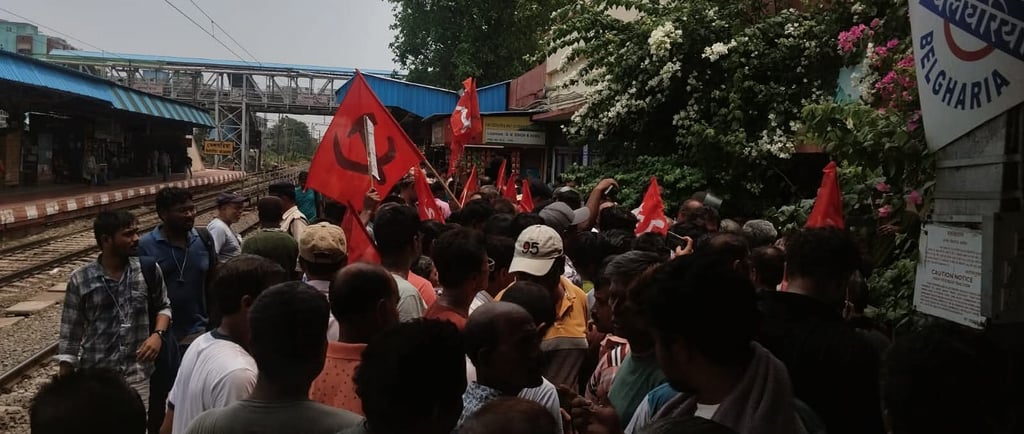
"Government officials, with bulldozers and uniformed personnel, turned stalls to dust in the dead of night, leaving hundreds of hawkers jobless in minutes.” ~ The Telegraph
The recent hawker eviction drive being carried out in different parts of Kolkata and all over West Bengal has led to uproars and protests from the progressive petty-bourgeois and a section of working-class people of our state, subsequently prompting a violent reaction from the state in suppressing such dissent. In reaction to this, the propaganda apparatus has been hard at work pushing the state’s justification for this action. Today, a multi pronged attack on these hawkers has begun questioning the legality of their usage of government land, questioning their economic status & ultimately justifying the attacks on poor hawkers most of whom live from hand to mouth. Thus, the first task is to dispel any misconceptions that arise as to what is a hawker, especially in the Indian context. A hawker is any vendor who sells goods or food in public spaces by travelling from place to place or establishing a temporary semi mobile/stationary setup. Prevalently they constitute a huge chunk of the informal sector, especially in FMCG, providing daily necessities to the working people travelling to the city from the suburbs, at an economical price point. Hawkers, as a broader part of the unorganized sector, represent nearly 85–90% of total retail volume in West Bengal. The increase in number of hawkers in Kolkata largely begun with the city’s post-colonial urbanization, particularly surging after the Partition of India, when millions of refugees from the then East Pakistan poured into the city, and set up temporary kiosks and vending stations on the streets, turning pavements into makeshift markets. The 1951 census found that only 33.2 percent of Kolkata's inhabitants were city-born, the rest were immigrants: 12.3 percent were from elsewhere in West Bengal, 26.6 percent from other Indian states, and 26.9 percent from East Pakistan. Today, about 38% of street vendors are native to Kolkata proper. The remaining 62% are from the greater metropolitan area or migrants from rural hinterlands. Overall, roughly two-thirds are from within West Bengal, with the rest migrating from neighboring states. This phenomenon of street-based retail is by no means unique to Kolkata. From the bustling tianguis of Mexico City and the warungs of Jakarta to the street hawkers of Lagos and Nairobi, these informal economies serve as a structural response to rapid, often uneven urbanization, providing essential goods and services to the working class while integrating migrants into the local economy.
A Rebuttal of the prevalent arguments for hawker evictions
Today, a large section of the upper middle class lauds the demolition drive and terms the suffering of the aggrieved due to illegal occupation of land. However, illegal occupation here reveals an obvious dichotomy. Illegal occupation is quite prevalent in the setting up of big businesses as well, where they gentrify and take over public spaces. Cafes encroaching on public paved pathways, to provide open seating for their customers, are not subject to the same critiques. Similarly, illegal occupation of reserved forests, protected lands, either by business or spurious religious structures is rarely remedied. Illegal construction, often taking the lives of people, as in the case of the Wow Momo factory disaster (which claimed 21 lives) in Kolkata, skirt far more regulations than mere hawkers.
Countless such cases exist, for poorly regulated brick kilns, fireworks factories, beedi factories etc. Nevertheless, such unlawful intrusions being frequently masked by a facade of aesthetics and illumination,are often overlooked under the guise of being "visually pleasing" or "economically advantageous." (perhaps because they impact real estate value positively to push the housing market out of the reach of the working class) The illegal occupation of government land becomes an issue for the upper middle class, insofar as they remain disconnected from economic exchange with the encroachers . Since the strata of people, who espouse commercialisation & corporatisation, do not interact with hawkers as such, to them, the impoverished and rudimentary appearance of the vendors is nothing more than a blight on the visual landscape. In these petty bourgeois today, the BJP government finds an enthusiastic base of supporters.
The forced removal of the hawker, from the local economy, artificially creates the space for the introduction of global market chains, brands and big vendors who will be given spaces at the stations to sell goods, as effectively as a monopoly. One of the arguments from the ruling section has been to allege that hawkers are not to be mistaken as economically impoverished or famished as they hide their wealth under a veneer of poverty.
However, in a direct rejection of the prevailing propaganda, studies have shown that up to 50% of the street vendors in Kolkata were once engaged in the formal sector. Many are retrenched factory and mill workers who were forced to turn to street vending when formal employment collapsed in the region. A foundational study by Sharit Bhowmik (2005) for the Ministry of Urban Poverty Alleviation found that Kolkata’s street vendors generated an annual turnover of exactly ₹8,772 crore (₹87.72 billion), yet the individual vendors remained below the urban poverty line due to zero asset retention. Similarly, a comparative study by Debdulal Saha (2011) in the Indian Journal of Labour Economics found that 0% of street vendors had access to formal bank loans for their initial setup, forcing nearly 100% of them to rely on informal moneylenders who charge predatory interest rates (often 5% to 10% per month). The socio-economic condition of the hawkers squalerly places them at the bottom quartile of the Indian economic spectrum, where the primary effort has been to consolidate wealth & opportunity and confine it to the upper echelons.
One must understand, that fabricated narrative to downplay the reality of the working class is the casus belli for the war being declared now at every station & bazaar. It has been further argued, that hawkers present a public nuisance, safety & security issue. Demonisation & dehumanisation is a tacit policy of the government which has been absorbed largely and further amplified by the Bengali Bhodrolok Class.
The demand of vendor zones too is a half hearted effort, to assuage the bleeding pockets of the working class. Research by Kumar and Singh (2018) into the National Association of Street Vendors of India (NASVI) found that to genuinely alleviate poverty, providing physical infrastructure, like designated vending zones, not enough. Their study highlighted that vendors require institutional power, legal protection, and business capacity building just as much as they need physical space, an advocacy effort that directly shaped the Street Vendors Act of 2014.
At the end of the day, one must remember, that the blue collar and white collar workers are socio-economically closer to these very people, being oppressed by the state. To not stand by them today, is to open the avenue for further repression as deemed convenient by the state in service of capital.
The Bulldozer Raj - An Instrument of State Repression
The use of bulldozers is no longer limited to the enforcement of municipal legislations, and regulations. It has increasingly appeared as a characteristic of government action in BJP ruled states as an expression of the will of the ruling dispensation. The term ‘Bulldozer Raj’ first appeared in 2017, in UP where “the bulldozer has been portrayed as a symbol of law enforcement in addressing property-related crimes, communal violence, rioters and alleged criminal activity. Demolition of structures has been increasingly reported in states with BJP leadership as a measure against illegal constructions Following its usage in political messaging in Uttar Pradesh, the bulldozer was used in Madhya Pradesh to convey political messages aimed at showing a strong stance against criminals.” There exist several examples, where a portion of or the whole building, whether it be commercial or residential, has been demolished with scant notice. As is obvious, protections against such drives, mandate the posting of notices and an appropriate period of appeals before any actions can take place. However, even after a Supreme Court order against demolitions, such drives are undertaken without much fuss in a large part of the country. Minorities and those who oppose the government disproportionately face such action. Timing of such is suspicious as those accused by the government are swiftly rendered a ‘dose’ of bulldozer justice. In such cases, the definition of demolitions in lieu of development do not hold much water. Just in UP alone, the number of displaced people rose from 107,625 in 2019 to 515,752 by 2023. In total, authorities demolished 153,820 houses in 2022 and 2023, leaving 738,438 people displaced. Evidently, there is no reasonable expectation of demolitions being restricted to hawker stalls. Though new in Bengal, one may reasonably expect such action to ramp up against political dissidents and anyone the government deems aberrant.
The fickle definition of legality & The futile hope of judicial relief
A large section of those opposed to Hawker Evictions, have claimed that ‘for once’ the law of the land, i.e. the constitution is on their side, as it provides safeguards against such action. For example, the Supreme Court of India’s 1985 judgment in Bombay Hawkers' Union v. Bombay Municipal Corporation established the principle that street vending was a constitutionally protected practice under Article 19(1)(g) of the Constitution (the right to practice any profession, or to carry on any occupation, trade or business), provided it was subject to "reasonable restrictions". However, as is increasingly clear, in the long reign of the BJP since 2014, the system of checks and balances has long been effectively eroded, in a manner beneficial to the ruling party itself. Even though, the Railway administration agreed to a halt of demolitions upto 21 days (after conceding the existence of legal provisions stemming from a 1988 court directive) proceeded with eviction drives. This was conducted in the dead of night, during a vacation of the High Court, so as to evade any sort of order which might be issued once the issue was heard by a bench. Wherever, resistance was put up, the crowd was dispersed by the police using unreasonable force to clear the path for bulldozers. However, the courts failed to undertake any meaningful proceedings as to a contempt of court by the railway administration. The Allahabad HC, in it’s recent judgement on the 6th of June noted, “The vertical loyalty of officers runs not toward the Constitution but toward the ruling dispensation. Field officers, acutely conscious of the transfer-posting economy, calibrate their conduct to satisfy political superiors”.
Thus, relying upon the court, and in turn conflating protections on paper as hope for those facing imminent danger only reinforces a sort of hoplessness in the long term. The existence of hawkers in these places isn’t a current occurrence. For decades, hawkers have operated within a system of informal payments and political patronage involving municipal authorities, police, and local power brokers. Their presence was not merely tolerated but often regulated, managed, and at times actively facilitated when it aligned with prevailing political and economic interests. What changes is not the letter of law, but the balance of class forces that determines how the law is enforced. Opposition to the hawker movement cannot be solely dependant on court arbitration, as the judgements themsleves are not insulated from the political atmosphere. Consequently, a judicial relief will only be feasible once the public pressure exceeds the will of the administration to undertake policies beneficial to it’s capitalist backers.
The Troubling Stance of the Bengali Bhodrolok class
In all this, the intellectual Bengali Bhodrolok middle class finds themselves in the midst of a deceptive and deceitfull jugglery and whataboutery to strengthen the hands of the fascist BJP government in this recent directive of trampling the poor working class families, applauding the destruction of livelihood of thousands of people in the name of Urban Aesthetics as the growing pains of developing economy ( a direct contradiction of the claim of being a bulwark of intellectual morality). They are dead silent when government gifts 1,020 to 1,050 acres of land to the Adani Group at the rate of just ₹1 per acre per year for over 30 years or the the proposed coal expansion in the Hasdeo Arand project being given to Adani ignoring the sustained indigenous and Adivasi opposition. The Bengali Bhodrolok loves to project themselves as the leading intellectual class of the Indian intelligentsia being historically progressive, enlightened and sympathetic to the poor, yet when the issues directly confront their urban comfort and questions of class conflict arise, this veil of radical rhetoric comes crashing down in an instant. Under the veneer of intellectual diversion they shift the focus from the real questions, fixating over what serves their class interest. In doing so the focus shifts from the structure that compels thousands to turn footpaths into a workplace for survival to the inconveniences that this compulsion creates for the privileged. The task at hand therefore, is to reject the social system that continually forces the working class to bear the costs of unrealized assurance of development while reserving its benefits for the rich. As long as the bourgeois state machinery exists and the private accumulation of capital take centre stage over the majority state constituents such conflicts will keep on arising with the working class having to pay the price each time.
FIND US ON
SUBMIT your ARTICLES
Subscribe
Connect with us