July Revolution of Bangladesh
An analysis of the changes in Bangladesh.
Team Subaltern
12/30/20259 min read
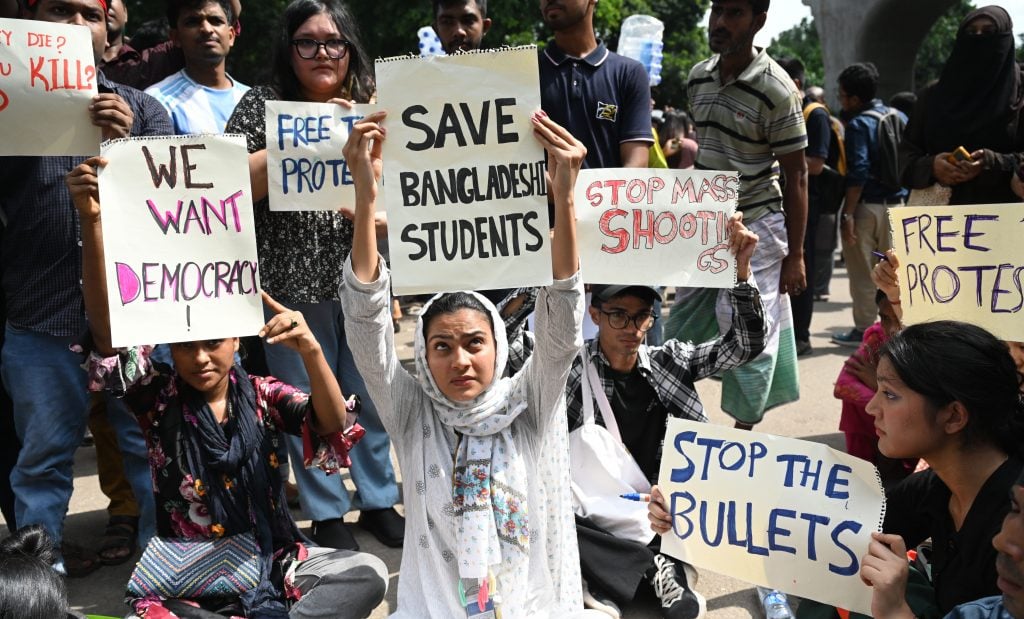
Parliamentary elections are scheduled to be held on 12th February 2026, in Bangladesh, for the first time since Sheikh Hasina’s government has been ousted. With communal violence at its peak in the country, it really begs the question of what led to the current political scenario since the student uprising that threw the Awami league out.
Since the Awami Leagues win in 2008 election, alongside 14 other parties, the League has had no intention of relinquishing its power. From 2008-2024 many factors contributed to the growing public discontent, like the suppression of opposition and dissent, election fraud, irregularities, corruption, and reliance on bureaucrats and administrative control to maintain power. Throughout years the economy of Bangladesh was strewn together by the Ready-Made-Garments industry, Aquaculture, Services sector to some extent. In 2023-24 when the global supply chain was disrupted and fuel prices shot up, inflation rose at its peak and a growing unemployed youth, all resulted in a mass hysteria, and people especially the youth tended towards Government jobs, which come with stability, that was lacking during times of capitalist crisis.
Now like all bourgeoisie governments, that try to appease certain sections of its population to fund their vote bank, and control political narratives among such sections, the Awami league too had reservations at the scale of ~30%, in the Government jobs, for descendants of the Freedom fighters. Prior to this, the reservation was there for the Freedom Fighters themselves, who took part in the Bangladesh Liberation War, and as their participation reduced naturally with age, the reservation was changed to give jobs to the children of the Freedom Fighters. Then as crisis came and the petty bourgeoisie mass started looking for answers as to why they had no jobs and why their future suddenly seemed all miserable, the anger was channeled towards the reserved categories. This can be seen even in other countries for example, in India, there is a huge discrimination towards reserved categories even till date. The problem that the reservation system tried to resolve, i.e discrimination and selective exclusion of minorities (who by actual figures are most of the population (non-General category) for hundreds of years) from education and other fields, just made ornamental changes. Reformists throughout the world have tried and failed in changing these long-standing culturally engrained discriminations through policies, the only way out is through emancipation by class struggle and establishment of a truly egalitarian socialist society, which can lay the bare foundations for a society free from all forms of oppression.
Although the case of India and Bangladesh are not exactly similar, a pattern can be easily established, where every time a crisis arises, the anguish of the population is directed towards the minorities, outbursts of which can be seen in recent incidents of harassment, mob-lynching and even killing of minorities by barbaric means in both the countries. We must refrain from propagating the agenda which divides the working class on basis of religion, caste, and race, we must remember that the true enemy of the people is Capital and whose very nature of exploitative class relations and philosophy of infinite growth gives rise to crises situation to begin with.
The student uprising in the mid-July of 2024, saw huge backlash from the government, which issued a shoot-at-sight curfew, killing hundreds of men and women on the streets, which infuriated the masses to revolt against the state. It saw some initial success with the resignation and expulsion of the Prime minister from the country and the abolishment of the discriminatory reservation system. As protests escalated and key points in Dhaka were overrun by crowds, the regime’s control eroded rapidly in late July and early August 2024. On 5 August 2024, Sheikh Hasina resigned as prime minister and fled by helicopter to India, entering self‑imposed exile and leaving a power vacuum. This power vacuum, was caused due to a lack of any revolutionary party that could give direction to the masses, was bound to be filled by the other organized sections (imperialist powers and their compradors, and the regional fundamentalist parties) resulting in the government of Muhammad Yunus who didn’t even took part in the revolution and rather was put in his position as a puppet of the national and international bourgeoisie. His government in no way or form represents the masses who took part in the revolution. The failure of non-partisan and independent movements such as the one in July revolution of Bangladesh shows us again that their philosophy is highly flawed and impractical. A mass uprising without a revolutionary party to direct it towards building a classless society will never by itself develop the consciousness, the movement will only be capitulated by other reactionary or even regressive sects which are able to capitalize on the anger of the masses. Numerous examples of this have been seen throughout history, such as Iran, Occupy Wall Street, etc.
Similarity with Iranian Revolution in 77-78
Let us talk a bit more about the Iranian revolution, and as we speak one might find similarities between the Iranian revolution of 1977-78 with the “revolution” in Bangladesh. The Iranian revolution began when millions of people took to the streets of Tehran, in 1977-78, demonstrating against the Shah and the monarchy. The oppression, torture and lack of rights and freedom brought upon the masses and especially the working class, by the Shah, by means of the SAVAK (secret police of Iran) and its authoritarian policies, led to the eventual fall of the monarchy in Iran. However, if we dig deep into the nature of the Iranian revolution, we will find that it too had a strong student movement. The ultra-left in Iran mistook the students as revolutionary by nature. But these “revolutionary” students, however, were not interested in the working class or formulation of a program for working class action. On the other hand, these “revolutionary” students were, directed by the sects, to appeal to means of individual terror. The students and the sects alike thought that the working class were impotent and incapable of organizing and powerless to change the relationship between forces in the country. Although there have been intermittent, yet frequent, general strikes organized by the advanced sections of the working class in Iran, such as the oil workers, to not work unless the Shah is dethroned, for which they had to face torture, death and humiliation like none other, their efforts went largely unnoticed by the sects. The Tudeh party, which is the Communist Party in Iran remained largely silent during the entire period of the revolution, because of the Russian bureaucracy's inaction and reluctance to face the American imperialist interests in Iran head on. The Russian bureaucracy wanted to avoid any direct conflict with American imperialism and instead propped up trade with the Shah, by buying large amounts of Natural gas and increasing trade, to provide silent support instead. Real tragedy in Iran was that there were no Marxists among the ranks of working class or the students who prepared for these great events that took place. The revolution in Iran began with way more consciousness than the Russian revolution in 1905. The Iranians did not appeal to “The Father”, the Shah, for changes towards betterment, rather they raised slogans like “Down with monarchy”, “Death to the Shah”. Iran had far greater working-class proportion (3-4 million in a population of ~35million) in comparison to Russia in 1905 (1-2 million in a population of 150million), with far better consciousness among the peasants than in Tsarist Russia, yet we see the revolution go into the hands of the fundamentalist mullahs. This was purely due to the failures of the left, their inability to organize the working class and prepare them for such a situation.
We see a similar situation in Bangladesh right now, with a large working-class population, which is paid dirt cheap minimum wage to produce the luxury goods for the West, has been left hanging by the inactivity and absence of a revolutionary party in Bangladesh. The communal tension, the anti-India and anti-minority rhetoric that is being spread amongst the masses not only misguides their anger and break their solidarity, this paves the way for a similar fate like Iran, and be captured by the fundamentalist Jamaat-e-Islami.
How the left became a marginalised section in Bangladesh Politics
It is not that the leftist parties were absent during the July revolution, but they have been long sidelined in the political landscape of Bangladesh. The Communist Party in East Pakistan (later Bangladesh) was divided into two factions during the Liberation war, one pro-Moscow faction that supported the Liberation movement and aligned with the Indo-Soviet socialist bloc supporting the Awami league in establishment of a “independent” bourgeoisie state and another pro-Beijing faction (groups like EPCP(M-L), EBSP) which called for a complete revolution through armed struggle, they continued their fight against both Pakistan and the Awami league(AL). However, the eventual decline of Maoism left the parties without any international support. Since the independence of Bangladesh, the Leftist parties that supported the AL during the War, faced huge suppression during Mujib’s regime. The 4th amendment to the constitution, 1975, by mujib granted the government full control over the press and media. In that state controlled public discourse model, the leftists' voices were further marginalized since freedom of expression, and any form of dissent was limited and suppressed. The JASAD (Jatiya Samajtantrik Dal) founded by Serajul Alam Khan, A. S. M. Abdur Rab, Abu Taher, and others, after splitting from Chhatro League (student wing of the Awami League). The gonobahini (militant wing of JASAD) led by Abu Taher carried out guerrilla operations against the autocratic regime of Mujibur Rahaman and propel into a socialist movement. After Mujib's assassination in 1975 the subsequent regimes shifted towards a market-oriented neoliberal economy. Zia’s military regime uplifted the ban on religious parties and his reconciliation with the Islamist groups sidelined Leftists in the broader political spectrum. Under Ziaur Rahmans regime, further crackdown on the gonobahini fragmented them. During the anti-autocratic movement during late 70’s the leftists aligned themselves with the centrist and right-wing groups, and after the fall of Ershad's government, the political spectrum was polarized between the Awami Leage and the Bangladesh Nationalist Party, sidelining the leftist's opposition into irrelevance. Today the work of the leftists in Bangladesh (Communist party (CPB), Workers Party, Socialist Party of Bangladesh, etc.) have grassroots operation in Unions, Garment factories, and rural communities. Unable to keep up with the neoliberal policies of the government, the operations of the party have been limited, and they are working along the periphery.
It can be understood from the above facts, that by repeatedly trying to avoid confrontation with the autocratic government and joining hands with other bourgeoisie parties at all levels resulted in the eventual slide into irrelevance of the leftists in broad political spectrum. Every militant regime has repeatedly crushed the working-class movement at every step, and the lack of united action on the part of the left has resulted in their own demise that we see today. Coalition politics with the right-wing led to limitation of the Left’s capacity in organizing, as the working class lost faith in the ability of the Left parties to give independent leadership and show them a path towards emancipation. Hence, we see radical parties gaining more popular support in rural areas.
Scenario in India
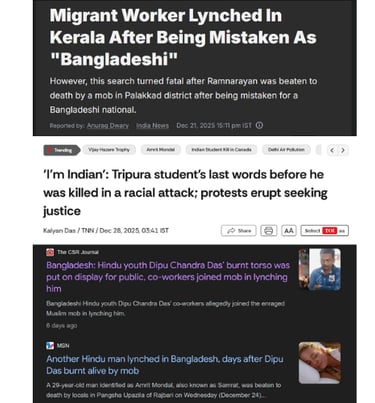
In India too, the ruling party, which is the parliamentary wing of the fascist RSS, is seen to instigate communal riots at different regions of the country. Workers from Bengal who immigrated to different parts of the country are beaten up, harassed, called as “Bangladeshi’s” and even killed for speaking their mother tongue.
Despite the polarization going on throughout the country, we see that the Parliamentary Leftist parties are silent, and many left-leaning, and radical left groups are falling prey to the “bait” where they end up giving in to the rhetoric of the ruling class, and merely speak of protection of minorities in all countries, although a fair and right demand, it only leads to capitulation of the leftist stance. The parliamentary left has been seen forming coalitions with the right-wing parties in India to fight fascism, this is a historical blunder on their part. It will only lead to the masses losing their faith on these parties, proof of which can already be seen, the largest worker and farmer unions (by numbers) belong, ironically, to the worker and farmer wings of the fascist party itself. Also grassroot level activity of the parliamentary left has diminished to almost nil, and the radical leftist groups that are working throughout the country amongst factory workers, gig workers and peasants and farmers are far too scattered to form a united resistance against the fascist aggression that is in display throughout the country, in the name of religion.
The formation of a united left front, to put up a fight against the Fascists throughout the country is of the utmost importance and unless the left realizes this, it is bound to assimilate into the same political irrelevance as in Bangladesh.
the above cases of beating and violence against the working-class people of both the countries are being portrayed by the fascists and the fundamentalists as an attack against “their religion”. We must refrain from being influenced by and propagating such rhetoric that divide the common man and pits them against each other. Rather, our focus should be on building working class unity among the workers of both countries.
Long live workers unity
Workers of the world unite against fascism
Down with fundamentalism

FIND US ON
SUBMIT your ARTICLES
Subscribe
Connect with us