Stifling of Student Unions: A case study on JNU
3/21/20264 min read
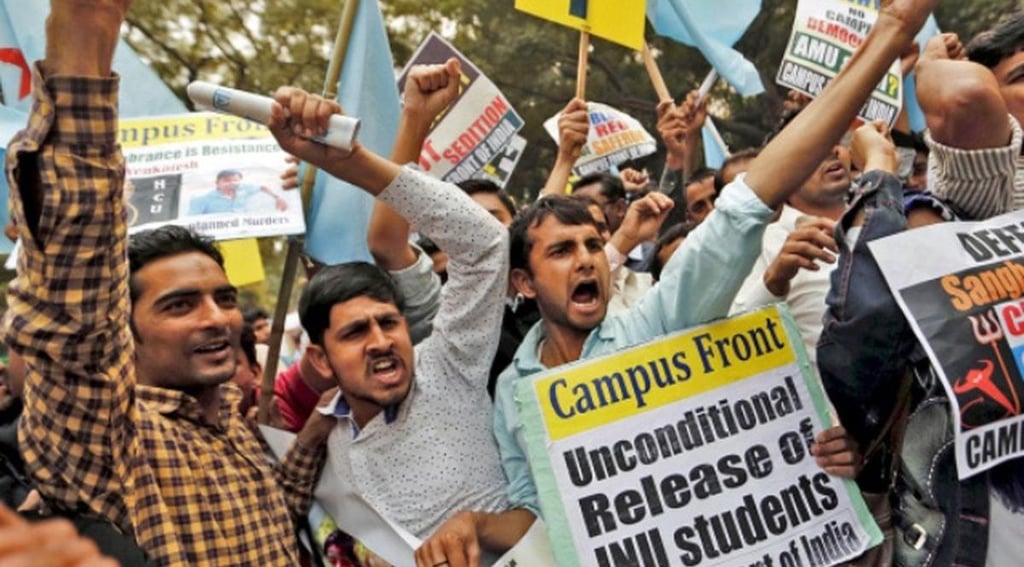
Since in 1969, Jawaharlal Nehru University (JNU) has been a place of critical thinking and opposition to authoritarian tendencies. It has consistently been a target of the Indian state's successive governments due to its progressive and anti-imperialist nature, from Indira Gandhi's Emergency (1975-1977) to Anti-CAA protests (2019).
Then from beginning of 2016 with around 35 FIRs and sedition charges against Kanhaiya Kumar , followed by a larger hostel fee hike in 2019 that triggered mass protests and police action, continuing with suspensions of student leaders, repeated police deployments, and arrests such as 51 detentions and 14 arrests in 2026, alongside a persistent “anti-national” narrative in sections of the bjp backed media, Prime Minister Narendra Modi's state apparatus, aligned with the Hindutva-capitalist nexus, is attacking JNU once more.
Recently on the night of February 25, students of JNUSU were preparing for a “Long March” to the Ministry of Education demanding implementation of the Rohith Act to address caste discrimination, the removal of Vice-Chancellor Santishree Dhulipudi Pandit over her remarks on Dalit and backward-class mobilisations, reversal of severe funding cuts, and the restoration of the University Grants Commission(UGC) equity regulations that had been put on hold despite being designed to ensure equal access and anti-discrimination safeguards in higher education.
From the beginning, the extent and character of Amit Shah”s DELHI POLICE response was heavy barricading, use of bomb squads and sniffer dogs, alongside the presence of armed forces like the CRPF and RAF, which went well beyond standard crowd control and had clear political motivations. Authorities successfully framed a student march as an issue of "National Security" rather than a democratic protest, treating it as a high-security threat.
The JNU students were in a spot. Fifty-one JNU students were arrested among which were Fourteen JNU Students Elected representatives. The police also made it very hard for JNU students to get out of jail by setting strict bail requirements. It seemed like the police and some people wanted to show JNU students as a threat, as troublemakers while completely ignoring the their democratic demands. This image of JNU students made people think that the police
A decade after the 2016 moment at Jawaharlal Nehru University, the most visible faces of that agitation stand in radically different political locations. Shehla Rashid has moved toward accommodation with the state and developmental nationalism Praising Modi Multiple times . Kanhaiya Kumar entered Mainstream politics through the Congress. Umar Khalid and Sharjeel Imam in the 2020 riots conspiracy case, meanwhile, remains incarcerated under UAPA, still awaiting the full course of trial. The collapse of the United Left in the 2024 JNUSU elections shows how internal divisions weaken resistance which helped ABVP to won the Joint Secretary post.
All 14 JNU students arrested in connection with the February 26 protest have now been released after a court order but the students of JNU, the JNU 14 and the All India Forum for Equity are asking for one thing. They want the rules about equality in colleges to be followed completely. These rules are called the UGC Regulations, 2026. They want to make sure that every college has a system in place to stop people from being treated. They also want a law called the Rohith Act. This law is named after Rohith Vemula, a student who committed suicide following alleged caste-based discrimination, suspension, and administrative harassment at the University of Hyderabad. His suicide note highlighted feeling alienated and oppressed by the systemic injustices he faced as a Dalit student on campus. This law would make caste-based discrimination in universities a legally punishable, non-bailable, and cognizable offence.
The students are also very upset with the Vice-Chancellor of JNU, Prof. Santishree D. Pandit. They want her to quit her job because of racist and casteist remarks on a podcast.
The students have other demands as well. They want the college to rescind the punishments imposed on all four office bearers of Jawaharlal Nehru University Students' Union and a former JNUSU president as they were rusticated, fined, and declared “out of bounds” (effectively debarred from campus spaces) after protesting against facial-recognition/CCTV surveillance in the library. The students also want the police to say apologize for breaking a picture of Dr B.R. Ambedkar during a protest. These are their demands. The campaign is now going to states in North India. It started in Rae Bareilly on March 12, then went to Darbhanga, Bhojpur, Samastipu, Lucknow and Patna on consecutive days.
The journey kept going through Ranchi, Sitapur, Basti and Delhi on March 17, ending with a final event in Allahabad, Patna and Delhi on March 18.
What happened at JNU can happen at any campus.
When the state takes action against one university by making arrests filing cases and harassing people with the help of the police it is actually sending a message to all the places where people talk about politics and question the government. If the state can stop people from speaking out in one place it is a warning, to everyone. This is a time when we all need to come. All the people who want change, who believe in equality and who want democracy must work together not to win elections but to protect the education that everyone can get to stand up against the state when it is being unfair and to make the voices of the people heard against the government and the companies that have too much power.
We demand unconditional release of the students immediately.
Stand in solidarity with JNU
Inquilab Zindabad !
FIND US ON
SUBMIT your ARTICLES
Subscribe
Connect with us