The Story of the Right to Work: MNREGA to VB GRAM-G and the Political Economy of Agrarian Distress
As the VB GRAM-G Bill is passed, we look at the MNREGA, what has changed, what remained the same.
Team Subaltern
1/24/20267 min read
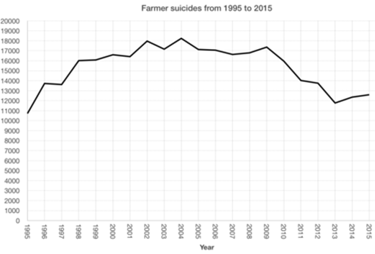
This was a time when the stagnation of wages, & the liberalization of the economy created despair among those who were dependant on the performance of the agrarian sector. A similar trend is visible in the NCRB data pertaining to farmer suicides, which rose steadily from the 1990s. The opposition in 2004, (Indian National Congress) found it advantageous to make the implementation of a rural publics works scheme a central plank of its election campaign, defeating the NDA & coming to power with the support of the parliamentary left.
Once in power, the UPA tabled a watered-down draft compared to the needs expressed by the advisory council as it refused to establish the right to work, & restricted the scheme to certain areas and periods of the government’s choice. Sub-section 6(1), inserted a week before the bill was tabled in Parliament, delinked the National Rural Employment Guarantee Act wages from the legal minimum wages (of the centre and states) and gave the centre powers to arbitrarily fix wages under the act. As recently as 2020, the MGNREGA wage was below the minimum wage for agricultural rural workers in 17 out of 21 major states, a direct result of the weakening of the intent of the bill under the UPA itself, supported back then by the CPIM which in its support of both landless workers as well as the farmer unions that agitated against NREGA failed to deliver a more meaningful gain for the working class.
In this context, Jens Lerche (2021), while noting the importance of a “broad-based political challenge to the increasingly repressive BJP government,” writes that “There is less reason to believe that this protest [farmers’ movement of 2020-21] will also usher in enduring popular alliances across the caste-class divide, between Dalit labourers and petty commodity producers as well as agrarian capitalists from farming castes. For most farmers, this is a contingent phase, a phase of alliance between groups that right now have interests that are sufficiently aligned for them to take action together, but in other ways are opposed to each other. When this struggle is over, one should not expect all farmers to stand up for demands by Dalits, Muslims, informal workers, let alone agricultural labourers.”
The final form of the bill remained at best a spurious instrument, aimed primarily to address the post-liberalisation agrarian distress, a transitional safety net for stabilising the reproduction of labour power under conditions of persistent agrarian crisis. Its significance lay not in resolving rural distress, but in temporarily containing its most destabilising effects by partially insulating livelihoods from market volatility. Nevertheless, it must also be noted, the establishment of the principle of a right to work, not as a gift, but as an inalienable right was an important achievement for the working class. Livelihood & dignity were now as an obligation of the state, not as a residual outcome of mindless growth. When well-funded, NREGA created an upward push on the wages of landless labourers allowing growth of real wages in regions once dominated by surplus labour (seasonally & otherwise) and depressed earnings. NREGA allowed for the rural women to enter the economy beyond the home by calling upon the duty of the state to provide employment upon demand of said citizen, enabling their limited but increased participation in male dominated migratory fields. It acted as a natural solution to the bonded labour (or semi-bonded) that existed, establishing a means for a stable income outside the established economic practices, for 100 days (when available).
The hostility that the bill thus received in terms of funding cuts, limited allocations, targeting is a reaction to the partial de-commodification of labour in an increasingly liberalized economy. The presence of the NREGA weakened the capacity of employers to mobilise surplus labour through wage suppression, seasonal insecurity, and localised coercion. Criticism of MGNREGA was often found as a critique of its fiscal prudence, inefficiency, or in the general disdain for ‘handouts’ from the urban elite. In the final days of the bill, the legal proceedings for the allocation of the funds, playing out between opposition ruled states and the NDA led centre often made the headlines, though one may blame the UPA which allowed for such dilution through the weaking of the bill in 2005. Consequently, under the unbroken rule of the NDA, NREGA was hollowed out with delayed payments, with compensation provisions ignored. Over time, participation declined not because need diminished, but because the costs of accessing work became prohibitive for many households which could not rely on the scheme as a pillar of income.
Thus, the final hurdle remained only in the structure and the precedence of the bill itself, which the central government finally repealed and passed by a rather quick vote in both houses of parliament. The Viksit Bharat – Guarantee for Rozgar and Ajeevika Mission (Gramin) Bill, 2025 (VB-GRAMG Bill) formally replaced what was left of the NREGA.
Ignoring the fortuitous naming of the bill, we focus on the most concerning parts of the law. The VB-G RAM G Bill increases the guaranteed workdays from 100 to 125 days per rural household annually. The bill simultaneously replaces MGNREGA's open-ended "Labour Budget" mechanism with state-wise "normative allocations." Under the old system, if actual demand exceeded projections due to monsoon failure or economic distress, the Centre was obliged to provide supplementary funds. However, the new bill, empowers the Central Government to determine each state's normative allocation based on "objective parameters" yet to be prescribed, while any expenditure beyond this allocation must be borne by the state government. By now delegating the matter of funds to the states themselves, fiscally constrained regions essentially will have an artificial cap on the number of beneficiaries of the scheme in a given fiscal year. The bill also introduces a 60-day "agricultural pause" during peak sowing and harvesting seasons which leaves the labourers once again at the mercy of the large landowners and cultivators who can again harness the labour surplus as a result of the migratory practices to supress wages and essentially tie the labourers to the farm, to work as bonded labourers in denigrating conditions for periods deemed advantageous by the state. Under the guise of technocratic centralization, the bill curbs the powers once granted to the gram panchayat, where the Gram Sabhas were once formally empowered to identify works, prioritise projects, and monitor execution. This becomes particularly concerning, as the works commissioned by these local governments often focused on ecological conservation, reconstruction & related projects which are seldom reflected by the policies set by the bourgeois government at the centre. Taking away this critical power, further allows the weaking of an already embattled federal structure which seeks to overturn grassroots collective bargaining power, already evident in the recent crackdowns in Ladakh.
This bill acts as a multi-pronged attack on democratic decentralisation, collective bargaining power, and heightened vulnerability to whims and exploitations of the big landlords and capitalists. Under the NREGA, the denial of work and withholding of funds were a breach of legal obligation, but the VB GRAM-G has now made it an inevitable and structurally permissible outcome, which has conveniently redefined the right to work out of existence. The alienation of labour from the pre-established right to work still remains the central theme of the new bill where the privilege to work may be awarded to the toiling masses, not based on local demands, power relations and gendered labour divisions, but as a means to achieve national directives on infrastructural needs defined by a governance structure insulated from the democratic pressures, driven primarily by the demands of its backers in big business which now seek to make inroads into the agrarian sector.
“Today the member of Parliament plays for an audience, the majority of which in most cases are workers, and he plays accordingly. There are very few of them who have not taken up at least one question of real or fancied interest to the workers as their speciality, from the legal eight-hours day to ‘England for the English’. Any question which a large section of the workers has at heart is sure to find a great number of advocates in the ranks of the middle-class legislators …. Politically as well as economically, it is fought by sections or divisions, and often in forms which are the reverse of what they ought to be according to the letter, so that it might appear as if it were not the social classes that contest with one another the control of legislation, but rather the legislators that fight for the satisfaction of the classes. But the class struggle is no less a reality because it has taken the shape of continuous barter and compromise.”
Though written in context of post industrialization England, it teaches much about the experience of the past two decades of increasing inequal growth & wealth gap, in India & where distress of the working class has been weaponised time and time again by the CPIM & members of the left front. The carrot of reform hung in front of the landless workers has only led to intermittent reliefs in form of such legislation which the reformists have championed. Whenever such legislation has had any potential for the alleviation of the position of the proletariat, it has been essentially paralysed by the agents of the bourgeoise. To this end, the pattern of the reformists to fight the matter in courts has yielded diminishing results, and whenever it has, the entire premise has been rug pulled by the very mechanisms the reformists seem to put their faith in. The natural consequence of this has been despair among those that these parties claim to represent. The state’s role here is not that of an arbiter, but of a collective capitalist, disciplining labour whenever reforms threaten profitability or control over surplus labour. The failure of reformist politics lies in mistaking juridical recognition for material power, and litigation for struggle. The nostalgia or yearning for failed schemes must be reoriented towards class struggle that targets the property relations and accumulation regime producing agrarian distress in the first place.
"The right to work is, in the bourgeois sense, an absurdity, a miserable, pious wish. But behind the right to work stands the power over capital; behind the power over capital, the appropriation of the means of production, their subjection to the associated working class, and therefore the abolition of wage labor, of capital, and of their mutual relations"
~Karl Marx, The Class Struggles in France, 1848 to 1850
The plans for MNREGA began taking shape all the way back in the early 2000s, as the Indian state under the first NDA government focused on fiscal austerity, liberalization, and schemes like Special Economic Zones which exacerbated rural joblessness and agricultural distress. The reaction of the rural wage labour found expression in the formation organisations such as the MKSS, (constituted in 1990 as a reaction to rural development programs like IRDP which suffered from corruption and non-payment of dues) agitating for greater transparency & improvement of wages.
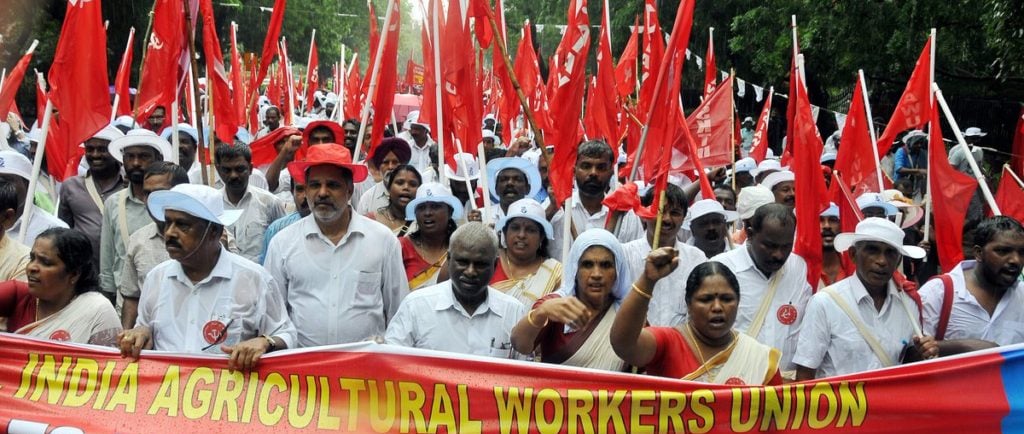
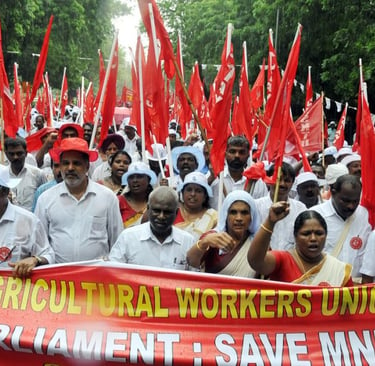
Demonstrations for the preservation of MNREGA, Delhi 2025
FIND US ON
SUBMIT your ARTICLES
Subscribe
Connect with us